


Israel Imposes Limits on Palestinians at Al-Aqsa for First Friday of Ramadan
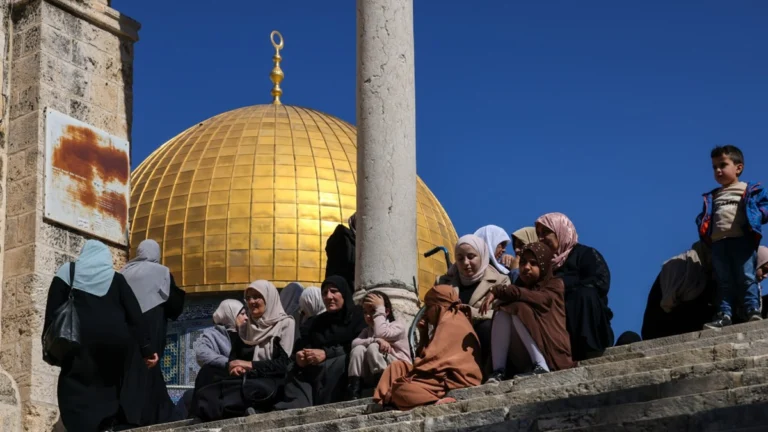
Palestinians near the Al-Aqsa Mosque, Feb. 20, 2026. X/ @Dogruhaber
February 20, 2026 Hour: 10:04 am
🔗 Comparte este artículo
Troop deployment and permit system sharply reduce attendance.
Israel has imposed severe restrictions on the entry of Palestinian worshippers to the Al-Aqsa Mosque, one of Islam’s holiest sites, during the first Friday of the month of Ramadan. The Zionist state also deployed more than 3,000 police officers in occupied Jerusalem and surrounding areas.
RELATED:
Gaza’s International Stabilization Force To Comprise 20,000 Soldiers
Israeli authorities announced they would allow the entry of 10,000 people through special permits. The decision significantly limits the rights of 3.3 million Palestinians living in the occupied West Bank. In previous years, attendance at the holy compound on this date exceeded 200,000 worshippers.
Additionally, Israeli occupation forces said they would only allow access to children under 12, men over 55 and women over 50.
Due to the requirement for “special permits,” only about 2,000 Palestinians were able to cross the Qalandiya checkpoint during the morning, one of the main access points between Ramallah and occupied East Jerusalem. Hours later, Israeli authorities said the quota had already been filled.
The deployment comes under a state of heightened military alert at checkpoints separating the West Bank from East Jerusalem. Hundreds of Palestinians were held for hours while attempting to attend communal prayers.
For Palestinians, attending Al-Aqsa during Ramadan is not solely a religious act. It is also a collective, historical, and cultural ritual that has been part of Palestinian identity for generations.
The mass restriction of access is seen as an attempt to fragment the territorial and social continuity between East Jerusalem and the rest of the occupied West Bank.
For thousands of Palestinian families, this Ramadan is unfolding under blockades, military checkpoints, and movement restrictions. What for decades was a day of mass gathering in Jerusalem is this year becoming a limited, conditioned, and closely monitored experience.
The situation reinforces the perception that the conflict is not fought solely on political or military ground, but also in the symbolic, religious, and cultural sphere, where access to holy sites carries a deeply identity-based dimension.
The ongoing limitations coincide with a significant rise in violence in the West Bank and East Jerusalem.
Since 2023, Israeli occupation forces and settlers have killed 1,100 Palestinians and forcibly displaced more than 10,000 people, according to data from the United Nations Office for the Coordination of Humanitarian Affairs.
At the same time, the Israeli government has approved measures consolidating the de facto annexation of large areas of the West Bank as “state property,” drawing international condemnation for undermining the Palestinian right to self-determination. More than 80 U.N. member states have formally rejected those plans.
Access to Al-Aqsa Mosque has historically been a central flashpoint in the conflict. Any significant change during Ramadan — one of the most spiritually sensitive periods in the Islamic calendar — carries a high potential for escalation.
The current restrictions drastically reduce the Palestinian presence in East Jerusalem, reinforce Israeli administrative and military control over access points, and directly affect collective religious practice.
Amid the genocide in Gaza and rising violence in the West Bank, the Israeli decision is interpreted by Palestinians and international organizations as a measure that deepens territorial fragmentation and structural control over the occupied population.
teleSUR/ JF
Sources: Middle East Eye – EFE